Choosing a First Tennis Match to Follow
Choosing a first tennis match to follow is easier with one point-level question: notice how a player builds an opening and make each rally easier to read.
Choosing a first tennis match to follow can feel like trying to watch the ball, both players and a scoreboard at once. Start with one question: how does a player build an opening in a point? That gives your attention a job without asking you to decode every statistic or tactic before the match has found its rhythm.
A tennis point is a small exchange of choices. One player serves; the other returns; both try to create a reply they can handle. For a first viewing, watch one player’s route from the serve or return towards a position where they can attack. Use the numbered plan below to choose a match, set your question and stay with it when the score or style changes.
1. Choose a match with a clear view of the players
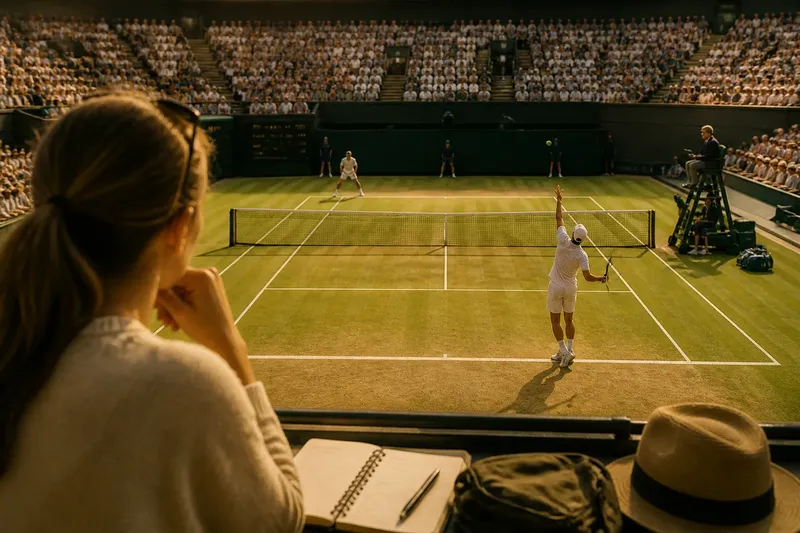
For a first match, choose a broadcast or seat where you can see the whole court and both players’ positions. A camera behind the baseline makes depth and direction easier to read than a tight view of the ball. If you are watching in person, a seat behind an end of the court offers a similar sense of where shots land and how players move.
The point is not to find the most important match. It is to reduce visual guesswork. A close-up can make a fast rally exciting, but it may hide whether a player has been pushed wide or has made space for a preferred shot. A full-court view helps connect the ball’s path with the player’s position.
Try a singles match if you want to follow one player’s decisions at a time. Doubles adds partners, net positioning and more rapid exchanges, which can be rewarding but gives a newcomer more moving parts to track. There is no wrong choice; pick the format that makes you curious enough to keep watching.
2. Give yourself one question to follow
Choose a question that can be answered by watching the point, not by memorising a statistic. For instance: how does the server create a manageable next shot? Or, when returning, does a player aim to keep the ball deep before trying to take control? Keep the question small enough to carry through several games.
“How does a player build an opening?” works well because it follows a sequence rather than a single highlight. Watch the serve, the return and the next shot. A powerful serve may not win the point outright; it may instead make the return shorter, leaving the server an easier ball to attack. The opening is that change in the rally’s balance.
Pick one player as your main subject. You can still notice the opponent, especially when they disrupt the pattern, but you need not explain both players’ intentions on every shot. Think of your question as a torch: it lights one part of the court without pretending the rest is not there.
3. Watch the first shot and the reply together
When your player serves, notice where the serve travels and what sort of return comes back. The serve can go towards the receiver’s body, out towards the side or into the opposite corner. You do not need to identify every technical detail. Ask whether the returner can take a balanced swing, and whether the server’s next shot looks comfortable or rushed.
On a return, look for the same chain from the other end. Does the return land deep enough to make the server hit from behind the baseline? Does the returner move forward, or stay back to protect against a strong reply? These are visible clues, not secret codes. If you cannot tell why a player chose a direction, simply note where the ball went and what happened next.
Imagine you choose a player whose serve often pulls the receiver towards the sideline. You notice that the next ball sometimes arrives nearer the middle, leaving room for the server to hit towards the open side. Your useful observation is not “the player has a perfect plan”; it is that the first shot can shape the space for the next one.
4. Follow the rally’s change of balance
A point can shift from defence to attack, then shift back again. Look for a player who has been moved away from the centre of the court, is reaching for the ball, or has to send back a high defensive shot. Those signs may give the opponent a chance to take the next ball early or direct it into open space.
Do not treat every forward movement as an attack or every retreat as a mistake. A player may move forward to meet a shorter ball, then retreat because the opponent has made a strong reply. The important question is what the position allows the player to do next. A brief pause between shots can help: where is each player standing, and who seems to have time?
For a first match, choose one kind of opening to watch. You might follow short returns, balls that push a player wide, or chances to approach the net. That single thread will still show you how the rally develops, but it will stop every unusual shot from becoming a new theory.
5. Let the score add context, not distraction
The score explains pressure, but it need not become your main viewing task. In standard tennis, points build into games, games into sets and sets into a match. A game can reach deuce, where a player needs to move ahead by two points to win it. Match formats and tie-break details can vary, so the on-screen score or event rules are useful when a format is unclear.
Notice the score when it changes what you want to watch. On a point that could end a game, for example, you might ask whether the server still tries to create the same opening or chooses a safer direction. Avoid assuming that one cautious shot reveals a player’s whole strategy; the score is context for a decision, not proof of a fixed intention.
Score graphics often show serve order, the game score and the set score. If you lose track, look at the scoreboard rather than trying to reconstruct each point from memory. That small reset lets you return to your chosen question without turning the viewing into a bookkeeping exercise.
6. Use a light note, then return to the rally
If you want to remember what you saw, make a short note after a game or change of ends. Write down the question, one visible pattern and one exception. For example: “Serve out wide; next shot towards the open court; returner began standing farther across.” The note records an observation without claiming you know exactly what either player intended.
Avoid trying to record every serve direction, winner or unforced error. Those terms describe particular events, but a list of them can pull your eyes away from the chain you chose to follow. A winner ends a point with a shot the opponent cannot return; an unforced error is a mistake made without the opponent’s shot being judged to have forced it. Neither label, by itself, explains how the point was built.
After a few notes, check whether your question is still useful. If the player’s serve is not creating clear openings, shift to a return question or watch how they cope when moved wide. Changing the question is not a failure. It is a way to make your attention fit the match you are actually seeing.
7. What should a new viewer notice?
Should I watch the ball or the players?
Keep the ball in view, but notice the players’ positions between shots. Their movement shows who is under pressure, who has room to choose and whether someone is recovering towards the centre. The point-level question connects those details without requiring you to watch everything equally.
Do I need to understand every statistic?
No. Start with the serve, return and next shot, then add a statistic only if it answers a question you already have. A serve percentage or break-point count can add context, but neither tells you on its own how a particular opening was created.
What if I cannot tell why a player hit there?
Describe the observable result instead: the ball went cross-court, the opponent moved wide, or the next shot landed short. Tennis broadcasts may show angles and replays, but your own reading does not need to match a commentator’s explanation to be useful.
Is singles easier to follow than doubles?
Singles often gives a newcomer a simpler starting point because there are two players and more space between them. Doubles brings partner roles and net coverage into the picture, so it can suit someone drawn to teamwork and quick exchanges. Choose the format that makes you want to keep asking questions.
Choosing a first tennis match to follow is less about learning everything before the first serve than choosing a question you can carry from point to point. Watch one player build an opening, notice what the opponent does with it, and let the score supply context when it matters. If a match leaves you wondering why one return changed the next shot, you have already found a good reason to watch another.