From Club Fixture Card to Live Scoreboard
From club fixture card to live scoreboard: see what each format reveals, why details go missing and how to read match information with confidence.
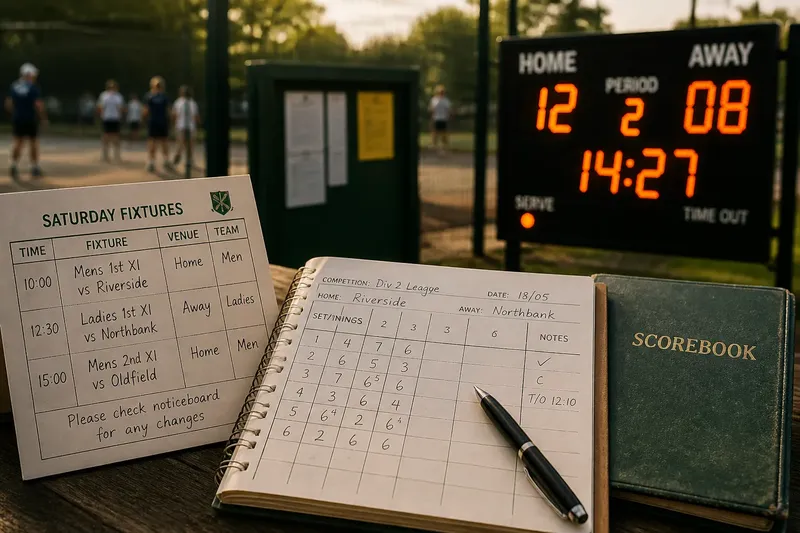
Why does a live scoreboard show the score but leave you unsure who is serving, which period it is, or whether the match has even started? From club fixture card to live scoreboard, the format changes what is easy to see—and what you must infer. A printed card gives you a stable plan; a display gives you changing information, often in a tighter space.
That difference matters when you arrive late, follow a match from the touchline, or try to check a result afterwards. Treat each format as a partial view rather than a complete record. When something looks wrong, identify which detail is missing before deciding that the score itself is wrong.
A fixture card is a plan, not proof of play
A club fixture card is built around expected events: opponents, venue, scheduled start, and sometimes the competition or team. It helps players and spectators work out where to be. Its main limitation is that it usually reflects arrangements made before match-day changes.
The trouble starts when a card is read as a live status report. A listed start time does not tell you whether the teams have taken the field, whether weather has delayed play, or whether a venue change has been agreed. Those details may sit in a club message, on a noticeboard, or with an official at the ground.
If the card conflicts with what you see, separate the planned fixture from the event now taking place. Check the club’s current notice or ask an organiser which fixture details have changed. Keep the original card as a reference, but do not use it alone to judge whether play is under way.
A paper score sheet preserves detail but can be hard to scan
Scorebooks and match sheets can record more than a headline result. Depending on the sport and competition, they may capture innings, sets, goals, substitutions, penalties, or the sequence of scoring. Their strength is the space to write a structured record; their weakness is that a reader must know how that record is laid out.
A common snag is mistaking a notation mark for a score change. A tick, a crossed-out entry, or a name written in a margin may record an administrative action rather than what spectators would call a point or goal. Handwriting and local conventions can make the distinction less obvious.
Start by locating the sheet’s headings and the relevant period or set, then follow the entries in their printed order. If a mark is unclear, ask the scorer or match official rather than translating it from a different sport’s conventions. For a spectator, the useful question is often not “What does this mark mean?” but “Which part of the match does this entry describe?”
A live scoreboard favours the present moment
An electronic display is designed for a quick glance. Large digits make the current score prominent, while a smaller panel may show the period, clock, team names, serve, or possession. The screen’s hierarchy is useful when you are watching from a distance, but it means some information receives far less space.
That can produce a familiar puzzle: the score is visible, but the context is not. A clock may count up in one sport and down in another; a period label may be abbreviated; a serve indicator may be easy to miss. The display can also lag behind play if an operator has not yet entered a change.
Read the display in layers. First identify the teams or sides, then the score, then the period or set, and finally any clock or status indicator. If the score seems out of step with what just happened, wait for the next update or check with the scorer. A scoreboard is a window onto the match, not the match’s entire record.
Why does the information seem to disagree?
Why does the fixture card show a different start time?
The card may show the original schedule while the venue or club has announced a delay or change elsewhere. Check a current club notice or ask an organiser before treating either time as the confirmed one.
Why is the scoreboard blank or showing an old score?
The display may not yet be switched on, may be awaiting an operator, or may not have received the latest entry. Use the visible play and the scorer’s current record as context rather than assuming the blank screen means no match is taking place.
Why does the score look different from the paper record?
The two formats may be showing different moments, or the paper sheet may include a detail the scoreboard does not display. Compare the same period or set and check with the official scorer if the discrepancy remains.
Why can’t I tell which side a number belongs to?
Team labels may be abbreviated, positioned above or beside the digits, or difficult to see from your angle. Look for names, colours, or home-and-away markers before assigning a score to a side.
Match information becomes useful when its limits are clear
Each format makes a different slice of the event visible. A fixture card foregrounds who is expected to play and where; a paper score sheet can preserve a sequence; a live scoreboard prioritises the state spectators need at a glance. None automatically answers every question about status, context, and history.
Say you arrive at a community court and find a card listing a doubles match, while the display shows a score with no player names. Check the court allocation and ask the organiser whether the listed pairing is still playing. Then use the display for the current score, while treating the card as the source for the planned fixture. You can now tell which information is current without pretending either source contains the whole picture.
Think of the formats as different windows, like a notice on a door and a clock inside a room: each helps with a particular question, but neither replaces looking at the event itself. For a club fixture card to live scoreboard, the most reliable habit is to match each detail to the source best suited to show it, then verify any conflict with the person keeping the official record.